
 Blue Sapphire – Neelam
 Yellow Sapphire – Pukhraj
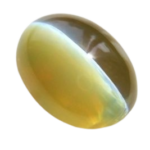 Cats Eye – Lehsunia
 Gomed – Hessonite Garnet
 Manik – Ruby
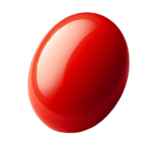 Moonga – Coral
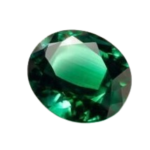 Panna – Emerald
 Pearl – Moti
 Citrine – Sunela
 Iolite – Kakaneeli
 Natural Zircon
 Opal – Doodhiya Pathar
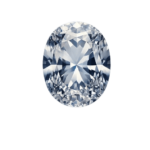 White Sapphire (Safed Pukhraj)
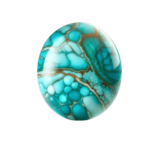 Turquoise – Firoja
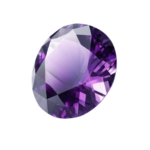 Amethyst – Katela
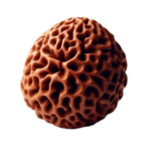 Rudraksha
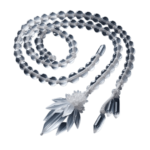 Sphatik
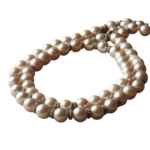 Pearl Mala

Quartz is a crystalline mineral made with silicon and oxygen, with or without small amounts of lithium, sodium, potassium, or titanium, which gives it a different color during formation. Many semi-precious gemstones belong to this group. It comes in a wide range of colors, making it a favorite among jewelry designers. The name “quartz” might have come from a word “quarza” in Eastern Europe, meaning “hard.” Silicate-rich fluids, open space like cavities and cracks, and slow cooling rates of rocks promote the formation of large quartz. Pegmatites rock cool very slowly, so it gives time for making bigger-sized quartz.
It mainly forms in 2 types: alpha, or low quartz, and beta, or high quartz. When crystallization forms at low temperature (below 573°C), alpha quartz forms through a trigonal crystal structure, and when crystallization forms at high temperature (above 573°C), beta quartz forms through a hexagonal crystal structure. Most quartz gemstones form as alpha quartz.
Quartz is a piezoelectric mineral, meaning it produces positive and negative charges on alternate prism edges when subjected to tension and pressure. When it is charged, it vibrates exactly 32,768 times per second. So quartz is a very accurate way of timekeeping and is used in watches. Its long prism faces always join at a perfect 60-degree angle. Quartz is divided into two main groups, macrocrystalline and cryptocrystalline.
A) Macrocrystalline
Includes more transparent to translucent stones like amethyst, citrine, smoky quartz, rose quartz, and prasiolite.
B) Cryptocrystalline
Also known as microcrystalline quartz or chalcedony. Includes translucent to opaque stones like carnelian, onyx, jasper, and agate. This classification is further divided into two varieties: fibrous and grainy.
PHYSICAL PROPERTY / COMPOSITION
Composition—Crystalline silicon dioxide
Hardness—7 on the Mohs scale
S.G. – 2.65 to 2.66
R.I. – 1.544 to 1.553
Fracture—conchoidal
Pleochroism—Yes, strong
Crystal structure—mostly trigonal
Luster—Vitreous
Transparency—Transparent to opaque
Cleavage – None
ORIGIN / SOURCE COUNTRY
Quartz is the second most abundant mineral (approx 12 %) after feldspar and forms in igneous, metamorphic, and sedimentary rocks. It is found worldwide, but gem-quality primary sources are China, Japan, and Russia. Other sources include Brazil, Belgium, Germany, South Africa, the U.S., and France.
DIFFERENT TYPES OF QUARTZ GEMSTONE
1. Amethyst
Amethyst is a variety of quartz that comes in various shades of violet. Amethyst is a February birthstone and is known for its protective qualities. In Greek, this stone is also known as amethystos, which means not to be drunk (a-not and methylene-to be drunk). Until the 18th century, amethyst was considered a precious gemstone. colour because of iron.
3. Citrine
Citrine ranges from pale yellow to deeper brown-yellow. It’s created when amethyst or smoky quartz is heated, either naturally or through processes. Citrine is often called the “Merchant’s Stone” for its association with abundance and prosperity.
3. Clear Rock Crystal – Sphatik
A white or colourless variety of quartz. This is the purest form of quartz with no trace element, which gives colour during formation. Rock crystal is known as the “Master Healer crystal” and is used for focusing and balancing the chakras. Its mala is used for its spiritual practice.
4. Smoky Quartz
A brown-colored quartz. The brown color happens because of the aluminum inside the rock. Smoky quartz is known for grounding and protection. It’s used to dispel negative energy in homes and offices.
5. Aventurine Quartz
Aventurine is a pretty rock that comes in a green colour with shiny specks. It is considered for luck and opportunity, and many decorative statues are made of this.
6. Rose Quartz
Rose quartz is a pink coloured quartz and known as the “Stone of Love.” It is associated with love, compassion, and emotional healing. The color comes from titanium, iron, or manganese inside it. Some rose quartz has shiny rutile.
7. Ametrine
Ametrine is a famous bi-coloured variety of quartz that comes with yellow and purple. Ametrine, especially from Bolivia, gets value because of its highly saturated colour.
8. prasiolite
A rare, green coloured quartz, colour often obtained by heat treatment of amethyst.
Other Varients
Blood jasper cufflinks, marion – black, aventurine, tiger eye, carnelol, jasper, agate chalcedony
USES OF QUARTZ
Primarily used as a gemstone in jewellery and for astrological purposes, other uses are;
A) Quartz sand or silica sand is used in casting, glassmaking, and ceramic production.
B) A building stone, sandstone, is mainly composed of quartz.
C) It is used to make abrasive products like sandpaper, grinding wheels, and polishing wheels.
D) Quartz is used in phones, video games, radios, televisions, camera watches, and many other electronic products for frequency control instruments.